Academic Program
Amani uses Responsive Classroom strategies to build a strong, respectful school community where students feel valued, take ownership of their learning, and develop the skills they need to succeed both in and out of the classroom. Responsive Classroom is an evidence-based approach to teaching that focuses on creating a safe, joyful, and engaging learning environment for every student
Curriculum & Instruction
English Language Arts
Fundations (Grades K–2) is used for foundational literacy instruction, offering a multisensory, systematic approach to phonics, spelling, and handwriting. The program supports early readers by building essential decoding and encoding skills through explicit instruction, consistent routines, and cumulative skill development. It serves as a key component of our early literacy framework, ensuring all students build a strong foundation for reading success.
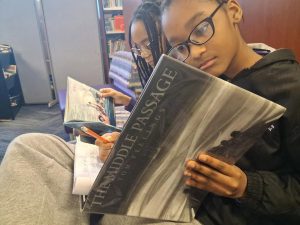
EL Education (Open Up Resources) is our core English Language Arts curriculum, designed to promote knowledge-building through engagement with complex texts, rich vocabulary development, and evidence-based writing. The curriculum is intentionally designed to integrate Science and Social Studies content, allowing students to build background knowledge across disciplines while developing literacy skills. This interdisciplinary approach deepens comprehension, fosters critical thinking, and supports meaningful connections between reading, writing, and the world around them.
In Grades 5–8, scholars engage with a wide range of literary genres and culturally responsive texts through our Novel Studies Curriculum, which complements the core ELA program. This curriculum promotes deep literary analysis, thematic exploration, and rich discussion of grade-appropriate novels aligned to the New York State learning standards.
Each quarter, scholars participate in an in-depth novel study, where they analyze rich, complex texts that challenge them to think critically, make connections across disciplines, and explore diverse perspectives. Lessons emphasize:
- Vocabulary development rooted in context
- Evidence-based writing that supports claims with text-based analysis
- Collaborative discussions that build academic language and comprehension
This approach nurtures a love for reading while strengthening scholars’ ability to interpret, discuss, and write about literature with insight and purpose. Through these studies, students grow as thoughtful readers, articulate communicators, and empathetic thinkers prepared for high school-level ELA and beyond.
Math
Amani utilizes the Illustrative Math curriculum, a problem-based core program designed to align with content and practice standards. This approach emphasizes deep conceptual understanding and active learning. Scholars learn by solving challenging problems, applying mathematics to real-world scenarios, and articulating their reasoning using precise mathematical language. Lessons focus on fostering critical thinking, collaboration, and perseverance as scholars work to master essential math concepts.
During math instruction there is ample time for exploration, practice, and discussion. This allows for a variety of instructional strategies, including hands-on activities, group problem-solving, and individualized support to ensure all scholars achieve their highest potential.
Science
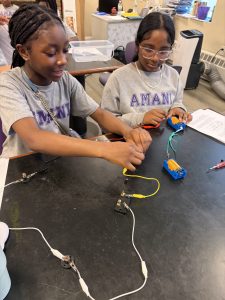
At Amani Public Charter School, we use Generation Genius as a resource to make science learning engaging, hands-on, and connected to the real world. Generation Genius combines high-quality science videos, investigations, activities, readings, and discussion opportunities to help scholars develop a deeper understanding of science concepts.
- 🌎 Earth and space science
- 🌱 Life science and ecosystems
- ⚡ Physical science, including energy and forces
- 🌦️ Weather and climate
- 🧪 Matter and its properties
- 🐾 Plants, animals, and adaptations
- 🌍 Human impact on the environment
Social Studies
Our Social Studies program is designed to be responsive to the New York State Framework, ensuring that we meet state standards while also remaining relevant to current events. We emphasize the use of informational texts to help scholars develop critical reading and analytical skills, allowing them to engage deeply with historical and contemporary topics. Through reading, writing, and projects, scholars apply their knowledge in meaningful ways, connecting classroom learning to real-world issues. This approach fosters a deeper understanding of the world around them and prepares scholars to think critically about the complexities of both the past and present.
Physical Education & Health
The Physical Education curriculum is designed to help scholars master gross motor skills and develop team-building abilities. Scholars engage in warm-up and cool-down exercises as part of their physical routine, promoting lifelong fitness habits.
Beyond physical movement, scholars also enhance their listening, speaking, reading, and writing skills by planning, organizing, and communicating during games and sports activities. Through collaboration and discussion, they develop interpersonal and character skills that support teamwork, respect, and a positive attitude toward active living.
The Health curriculum for grades 5–8 provides scholars with the knowledge and tools to make informed decisions about their well-being. Scholars focus on healthy lifestyles and essential life skills, learning how to adopt behaviors that reduce health risks and promote safe, healthy living.
Together, our Physical Education and Health programs support the holistic development of scholars—physically, socially, and emotionally.
English Language Learners
English Language Learners are held to the same rigorous academic standards as all scholars. Language proficiency should never limit access to high-quality instruction. Instead, teachers provide appropriate linguistic scaffolds that enable scholars to engage meaningfully with grade-level content while developing proficiency in listening, speaking, reading, and writing. As scholars progress through the NYSESLAT proficiency levels, instructional support should gradually decrease while opportunities for independence, academic discourse, and complex language increase. This approach is consistent with NYSED’s vision that multilingual learners develop English proficiency while simultaneously mastering grade-level academic standards.
we are committed to ensuring that all Multilingual Learners (MLs)/English Language Learners (ELLs) receive the support necessary to access rigorous, grade-level instruction and achieve academic success. The identification, placement, and support of ELLs follows New York State Education Department (NYSED) requirements under Part 154 regulations.
Special Education
We are committed to ensuring that all scholars—including those with disabilities—receive the support they need to succeed academically, socially, and emotionally. We proudly follow the New York State Education Department’s (NYSED) Blueprint for Improved Results for Students with Disabilities and work closely with each scholar’s district of residence to deliver the services outlined in their Individualized Education Program (IEP).
Although Amani operates as a Local Education Agency (LEA) for general education, Special Education services are governed by federal law. That means the public school district where a scholar lives (e.g., Mount Vernon City School District, NYC Public Schools, Yonkers Public Schools) is legally responsible for evaluating the child, developing the IEP, and ensuring that all services are provided in accordance with the Individuals with Disabilities Education Act (IDEA).
How Special Education Works at Amani
At Amani Public Charter School, we are committed to ensuring that every scholar has access to high-quality, equitable education. Our Special Education program is designed to meet the diverse needs of students with disabilities while maintaining high expectations for academic achievement, social-emotional growth, and independence.
Inclusive, Standards-Aligned Instruction
Special Education services at Amani are grounded in inclusion and differentiated instruction. Scholars receive support in general education classrooms whenever possible, with individualized accommodations and modifications that allow them to access the same rigorous curriculum as their peers. Teachers collaborate closely with Special Education staff to embed strategies such as scaffolding, visual supports, and targeted interventions into daily instruction.
Individualized Education Programs (IEPs)
Each scholar receiving Special Education services has an Individualized Education Program (IEP) that is collaboratively developed with educators, families, and, when appropriate, the student. IEPs outline measurable goals, accommodations, and related services tailored to each student’s strengths and needs. Staff regularly monitor progress toward these goals and adjust instruction to ensure students are supported in reaching their full potential.
Response to Intervention
Response to Intervention (RTI) is an essential component of our Multi-Tiered System of Supports (MTSS). RTI is a general education initiative focused on early identification and support for students who may be struggling—academically or behaviorally—before more intensive services are considered. RTI ensures that all students receive timely, data-informed interventions in a supportive environment.
This helps prevent unnecessary referrals to special education by making sure every effort is made within the general education setting first.

